
Research & Engineering Tools
Follow the inputs.
Inspect the result.
Calculators, experiment workbenches and interactive reports with visible evidence and assumptions.
First worked example · SAMPLE
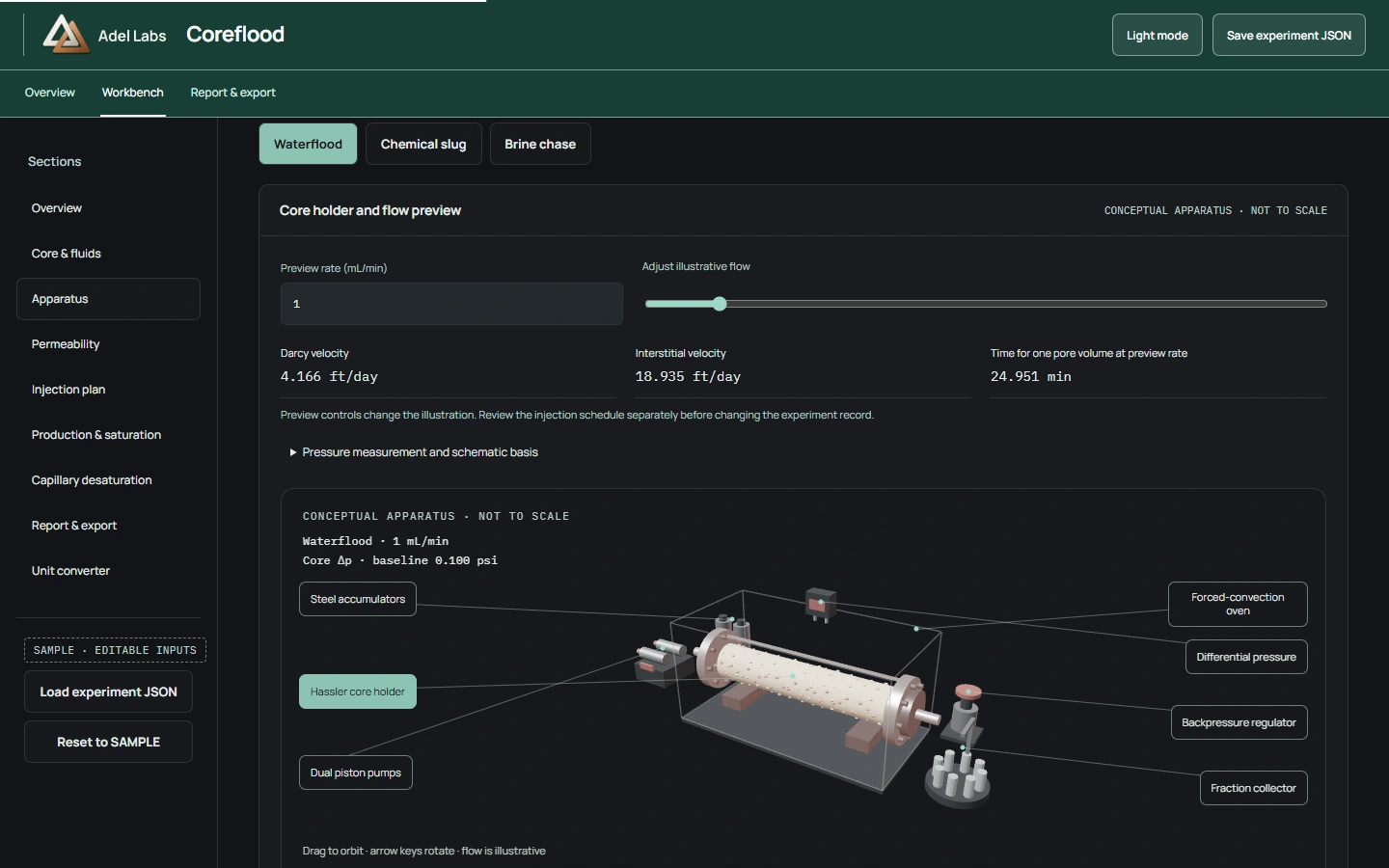
Institutional research is presented separately from Adel Labs client work. These studies do not imply endorsement of Adel Labs by any institution or funder.
Phase classification and interfacial tension require observations or independent measurements. Examples demonstrate their stated capabilities. Your proposal defines the deliverables and checks for your project.
-
01 · Supplied records
Measurements and source material, with units as supplied.
-
02 · Calculation
Stated equations with units, assumptions and applicable ranges.
-
- Units
- Source values
- Worked check
03 · Checks
Representative results compared with the source and an independent worked check.
-
SAMPLE · illustrative
04 · Inspectable report
Figures follow their calculation; exports match the displayed result.
Your task
Measurements, equations and interpretation need to remain connected as a reader explores a result.
What you receive
A working tool or report with stated units, source material and calculation checks.
What you provide
Source material, units, assumptions, intended reader and required export.
Scope, deliverables and acceptance checks
Scope and deliverables.
Your proposal identifies the included deliverables and their checks. The outline below helps define that scope.
Experiment planning: test matrices, screening criteria and planning views tied to the physical constraints of the program.
Acceptance criteria
Trace each planning constraint and screening criterion to the supplied basis.
Data-analysis workbenches: supplied measurements, fitted relations and derived quantities kept distinct, with their applicable ranges.
Acceptance criteria
Compare loaded measurements and fitted outputs with the source, including units and fit limits.
Engineering calculations: correlations and equations with explicit units, assumptions, references and limits.
Acceptance criteria
Verify representative calculations against the stated equation and an independent worked check.
Interactive schematics: calculation-driven figures respond to the same inputs as the numerical result; static measured figures remain labelled.
Acceptance criteria
Change an input and confirm that the associated computed figure and result agree.
Teaching companions: course material connected to worked examples, calculations and visual explanations.
Acceptance criteria
Check a worked example and its supporting course source.
Technical reports and research hubs: clear routes to supplied manuscripts, data packages and presentations.
Acceptance criteria
Open the approved source files and references from their published or packaged destinations.
Standalone reports and workbenches: package figures, calculations, source references and interface assets for use on your hardware, including local import and export where required.
Acceptance criteria
For offline scope, open the delivered package without a network connection. Check a calculation and compare the exported result with the displayed output.
Calculation and export checks: results and figures checked against supplied data, with output files and operating notes at handover.
Acceptance criteria
Compare exported values and figures with the displayed result and document any limitations.
First engagement
One calculation, module or report prototype with its basis visible.
What sets the fee and schedule?
- Source quality, data preparation and the number of calculations or modules.
- Reference checks, required exports and the depth of validation.
- Interactive figures, teaching material and the intended reader’s technical level.
These inputs determine the proposal. No fee or delivery date is fixed before the included work and dependencies are agreed.
Keep the basis visible
Figures follow their calculation.
Interactive calculated figures respond to the inputs that produce the numerical result. Static measured figures remain labelled with their source. Assumptions, units and applicable ranges stay beside the output.
Supplied measurements, derived results and interpretation remain distinct. Institutional research retains its attribution; it is presented as evidence of the work performed, without implying a commissioned client endorsement.
Scope, exclusions and handover
New laboratory measurements, independent certification and validation beyond the supplied evidence are outside scope unless agreed. Research examples retain their institutional attribution and do not imply a client endorsement.
The proposal identifies the source, configuration, access and operating notes included at handover. Third-party software and model licences remain applicable. Maintenance, update testing and further development are scoped separately.
Fees, handover and after-launch questions → · Ongoing care →
Research & Engineering Tools
Which calculation or result needs to be easier to inspect?
Bring the source material, intended reader and required output. We can then define the calculation checks and operating limits.